Tuesday, 24 April 2012

Review: Sweeney Todd (Adelphi Theatre, Saturday 21st April 7.30pm)


When I first heard that Michael Ball would be playing Sweeney Todd it was hard to imagine. How could the nicest guy in musical theatre effectively portray one of musical theatre’s most dark, tortured and vengeful characters? Michael Ball is a man with a gentle demeanour who croons ‘Love Changes Everything’ whilst displaying a big, cheesy, amiable grin; Whose recent other roles have been the family friendly ‘Chitty, Chitty, Bang, Bang’ and ‘Hairspray’.

I’ll tell you how he effectively portrays it  – because he’s a damn good, versatile actor. Despite this being a million miles away from the roles we’re used to seeing him in, he doesn’t merely pull it off, he owns the role and brings a presence that is truly scary and intimidating.

I watched an interview with him earlier on ITV’s Loose Women and they said some people haven’t even realised that they are watching Michael Ball and (although I wonder why they haven’t at least glanced at the cast board) I can see how if you didn’t know he was in it, you wouldn’t realise. Not just because, visually, he looks so different with his slicked down, greasy hair and beard and moustache combo but because he immerses himself so completely inside the character of Sweeney Todd, completely burying his nice guy image under the weight of this tortured soul. And that can’t be an entirely comfortable place to be night after night!

But as many great playwrights have known since the Greeks put on their first play - when you have a heavy, dark subject matter you need to splice in some humour to really make it hit home. The sublime to the ridiculous, as my English teacher would have said. And this is where Imelda Staunton shines as the truly psychotic Mrs Lovett. Her comic timing and delivery is perfect and doesn’t miss a beat; She has all the audience howling with laughter often throughout the show.

This, perhaps, helps to create an even thicker disturbing atmosphere when we realise we’re laughing even during the horror playing out before us.

One of my favourite parts is the ‘A Little Priest’ scene, after Sweeney Todd declares vengeance upon the entire human race and Mrs Lovett realises she can use Sweeney’s victims as the meat for her pies! – the subject matter may be terrifying but the song is jovial and trivialises the situation to a simple business transaction. This scene really highlights the chemistry between Michael Ball and Imelda Staunton as they bounce off each other and this is delightful to watch as an audience member; Good chemistry between the lead actors can make such a difference.

I think it’s important to also mention the ensemble in this review as they are an integral part of the production. They pitch in at pivotal moments with their ‘Ballad of Sweeney Todd’ a discordant and disjointed eerie song requiring harmonies that both blend and clash. Each ensemble voice is heard and there’s not a weak link in the chain.

I’m going to mention Adam Pearce in particular as I enjoyed his facial expressions during the shaving contest between Pirelli and Sweeney and think that this added an extra element of humour to it.

There’s  some striking images during the production, for example, when Sweeney Todd says ‘At last.... my arm is complete’ and holds up the razor. He is lit in a prism of light focusing our attention on the new extension and what that means for the story to come.

Sweeney Todd is at the Adelphi Theatre for a limited run until September 22nd, so I urge you to book now. This is one not to miss.

Check out the official website http://sweeneytoddwestend.com/ for more information & to book tickets.

Wednesday, 29 February 2012

To See or Not To See?


That really is the question, when you don’t have all the shows on your doorstep. Going to see London shows, for me, isn’t just the matter of a cost of a ticket – it’s the travel, hotel and cost of meals whilst there.

Perhaps this is partly my fault for wanting good seats (my favourite seats are in the stalls, about 5 or 6 rows back, centre of the row  – very expensive). But if I’m going to spend all that money on the overall trip, I want to have a good viewing position.

So, how do I decide what to see? Here are the factors that contribute to the decision making process:-

  •         The shows that are only there for a short run have to be top of the list otherwise I’ll miss them.
  •          Next will be the shows I’m really excited to see, but seem to be quite settled in their homes and don’t look like they’re going anywhere anytime soon.
  •          I like to go see every my all time favourites every few years, such as Phantom and Les Mis. If there’s a particularly strong cast this will bump them up (With all the Phantom25 celebrations at the moment, I’m getting to see this quite a lot, which is great)
  •         Shows that are getting rave reviews and have a bit of a buzz about them, but aren’t one’s that I feel a massive urge to see .


About the last factor - when I do go to see these shows, I’m more often than not completely blown away – for example, Lord of the Rings, which I ended up going back later that month to see (at the time I was living in Croydon and it was much easier to go). It’s just a shame I rarely get to these ones.

If the show is touring and it’s coming near me, I’ll probably go and see that version instead, although I’m aware I’m getting a watered down tourable version, such as Legally Blonde later this year.

Another factor that, unfortunately, plays a part in the decision is whether anyone else wants to see the show. It shouldn’t be a factor,really, I should feel happy to book on my own rather than miss something I really want to see. It seems from a poll question I put forward on www.stagestatus.com that most people aren’t afraid of going alone:-


 If I answered this poll, I would have probably said ‘No, I would be too self conscious’. Hopefully, this year, I’ll get over that. I even think that once I do it, I'll prefer it because I often end up worrying that the person I've taken to see the show isn't enjoying it, which spoils my own enjoyment. 


After I’ve made the decisions about the West End shows, there’s also the decision about what local shows to see, to fill the gap in between. I’ve posted before about the different qualities of amateur dramatics. There are some real hidden gems out there. But for every amateur company which shines, there are a handful of duds. These are often full of casts who have no propensity for acting and are doing it as a hobby. This is fine, I have no problem with people trying, just don’t charge audiences £10 for the privilege of watching them try.

The other problem with choosing local shows to watch is finding the venue! – in London all the theatres are lumped together, very efficiently, in theatre land. In the instances when it’s not in theatre land – it’ll be in a very accessible position at the end of a short tube journey.

I had an incident a week or two ago where I was going to a venue outside of the centre of Swansea. I hadn’t been there before and despite living in Swansea for most of my life, I don’t know my way around here very well. I typed the post code into google maps and was given a location. I felt happy I could get to this. Unfortunately, it turned out this wasn’t where the venue was at all, and I was lost. I had no idea where it actually was and ended up missing the show.

I love seeing shows and there’s no way I would let all the above put me off enjoying something that I have loved my entire life. It would just be so much easier if I didn’t live the wrong side of the M4.

To see or not see? With all these things to think about, it’s not such an easy question, after all. 

Monday, 20 February 2012

What's On Stage?


... Errr... well... nothing,  according to critic Michael Coveney, or nothing worth seeing anyway. This interview being one of the low points at last night’s whatsonstage.com awards (or high points depending on how sadistic your viewpoint is)

If you didn’t see it, because you were actually there enjoying the live performances that those of us watching online weren’t privy too, I’m sure you’ve already heard about it. Yes, perhaps he was slightly intoxicated but for a renowned theatre critic who writes for whatsonstage.com themselves to not be able to pull his thoughts together at an awards ceremony for the very industry he critiques is very embarrassing and was horribly cringeworthy to watch.  I wanted to be able to post a link to a clip, for those of you who missed, but rather unsurprisingly there was nothing to be found.

That aside, I found the whole evening a bit disappointing, which seemed to be the general consensus from fellow tweeters. I suppose the problem of having the awards voted for by the theatre goers themselves is that, having not seen all the nominees, most votes go to the popular ones that everyone is familiar with ... hence the reason I don’t vote in these awards – I feel it’s only fair to vote if you can give a well thought out, reasoned, balanced vote having been to see all the nominees... or at least a good proportion of them. Unfortunately, I can’t get to London often enough for that to be the case.

I think this bias towards the more “popular” nominees was demonstrated in the results. Especially when you consider that Amanda Holden won the award for Best Actress in a Musical. I haven’t actually seen any of the actresses nominated, but I have heard so much better things about Caissie Levy, for instance and twittersphere seemed to agree that the Matilda girls should have won it.  

Again, there was outrage on twitter when the Theatre Event of the Year award was given to the reunion of Catherine Tate and David Tennant. This is not an event, the people cried. It seems so unfair that it went to this rather than the Phantom 25th Anniversary, or at the very least, Michael Sheen’s Port Talbot based ‘Passion’ play – both of these being actual events, rather than clever casting decisions.  Maybe this award needs better guidelines as to what constitutes an event.

Another perplexing aspect to the evening seemed to me the decision to employ Alan Davies as a host.  Did this decision happen after asking Sheridan Smith to host because of their connection through Jonathan Creek? At first, his between awards banter was very funny, it has to be said. But as the evening wore on (perhaps again to a slight inebriation) it got slightly irritating and repetitive. The Benedict Cumberbatch joke definitely got to a point where you could hear the slightly awkward laughter of a Sheridan trying to politely move it along. And his excitement at getting to the last few prompt pages of the awards evening was more than just a joke, it seemed. Something tells me he didn’t particularly want to be part of this evening at all.

There were some well received winners though such as 'One Man, Two Govnors', for best new comedy and 'Sweeney Todd' for Best Regional Production. The most notable and well celebrated winner being 'Matilda the Musical', which looked as though it wasn’t going to get its recognition until the end of the evening, where the show swept up Best Choreographer (Peter Darling), Best Newcomer (Tim Minchin), Best Set Designer (Rob Howell) and – the icing on the cake – Best New Musical (and looking at the statistics it won quite comfortably).

I was pleased that those of us who couldn’t attend the ceremony got to share the experience online, even if we had to miss out on the performances – but then, if we had been allowed that privilege we may have missed out on that wonderful interview with Michael Coveney.

To see the results and the corresponding voting statistics, along with pictures from the evening, please go to http://awards.whatsonstage.com/index.php

Monday, 6 February 2012

Review: Les Miserables, Queen's Theatre, London, Saturday 4th Feb 7.30pm


I can’t begin to review this performance without first acknowledging that Ramin Karimloo was scheduled to be Jean Valjean on this evening but had to pull out due to sickness. Like many people in the audience, I had chosen to see les mis on this occasion over all the other shows primarily to see him in this role. And I’m not going to lie, I was crushingly disappointed.

That being said, it is the nature of live, long running theatre that you can never guarantee what performer you will see. Everyone gets sick now and again, especially when pushing themselves hard, as Ramin has been. Would you go into work if you were sick? Let this be a reminder that when you book to see a show, you are doing just that – booking to see the show, not the performer.

Robert Vickers was the understudy on this occasion and it cannot have been easy performing to an audience full of disappointed people expecting to see Ramin. It was obvious that he was giving the performance everything he had, I don’t think he could have tried harder. The only problem was his voice just wasn’t strong enough, struggling to hold the crucial note at the end of  ‘2,4,6,0,1’ in ‘Who am I’ and again during the dying scene. With the latter he tried to cover it up by turning it into the pain the character would have been feeling, which was entirely plausible, but it was still a definite glitch. There was also a moment, where he must have picked up the chair in the wrong way after the confrontation scene and it fell apart in his hands.

It must be noted that Robert Vickers is the 2nd cover and possibly not well rehearsed and much less familiar with the part than even Christopher Jacobsen (1st cover) would have been. There was someone at the front of the auditorium who was showing a lot of encouragement for him with much cheering after the big numbers and I’m pleased that he had this support. It’s just unfortunate that some less forgiving theatre goers around me wouldn’t put aside their disappointment to appreciate what they did have.

And what we did have was an otherwise brilliant cast. There were 2 other understudies performing on this evening and they were two that I’d actually been hoping to see over the main ones - Fra Fee as Marius and Scott Garnham as Enjolras.  I’ve been aware of them for a while and heard only good things and they didn’t disappoint.

The female leads were technically very good, even if I wasn’t blown away. Alexia Khadime as Eponine has a strong voice but at times it got a little too nasally for my liking. Perhaps I was always going to be harsh in my opinion of Eponine, though, as Samantha Barks was perfect in that role to me.

I have to give mention to Katy Secombe (who, I later found out, is the daughter of Harry Secombe) and Cameron Blakely as the comic relief in the form of the Thénardiers. I particularly loved the part during the beggars banquet where Thénardier spins her right off into the wings, literally stopping the show as if it were a mistake – nice touch.   

For me, the absolute standout performance goes to Hadley Fraser as Javert. There is something reminiscent of Philip Quast’s Javert in his sneering portrayal and he has this presence that is essential for the character – an oppressing authority with unwavering conviction in what he believes is good & bad. Hadley is well matched to this role, much more than he was to the role of Raoul for Phantom 25.

A note to the director, though – can’t something be done about Javert’s exit after his suicide? The rolling off stage always makes me laugh in a moment which is supposed to be sombre and I heard someone behind me chuckling too. It is a bit of a moment killer.

I also want to give some recognition to James Charlton, a swing filling in one of the student roles. There was something magnetic about him, that stage presence which pulls  ones attention and he has this. I particularly liked an interjection he made after Grantaire sings ‘I’ve never seen him ooo and ahh’ after which he pitches in with ‘Oh, this time you’ve gone too far, Grantaire’. I don’t know if that’s always in it and I’ve just never heard it so clearly or if he adlibbed it. Whichever way, it made me smile.

I really noticed the use of cold, uplighting during this performance highlighting the more sinister turns – for example the latter half of ‘lovely ladies’ where it turns from being a fairly light-hearted look at the life to which these women have resigned themselves to the nightmarish reality – an atmosphere created purely by a small change in lighting state creating looming shadows against the grey wall behind them. The same technique is used for the transition from the wedding chorale to beggars at the feast where the Thénardiers take over the scene and it’s transformed into something distorted.

So, Ramin may not have been in it, but it’s still an amazing show and a captivating, heart wrenching story put together into this phenomenon that has seen many performers come and go. A production that is worth booking whether there’s a well known performer or not. I’m not saying there weren’t times I was wondering how Ramin would have sung certain parts or how he would have portrayed the character, but that wasn’t how it worked out and sometimes you just have to except that, move on and enjoy the show and the cast you are presented with.  You may even discover someone new. 

Saturday, 21 January 2012

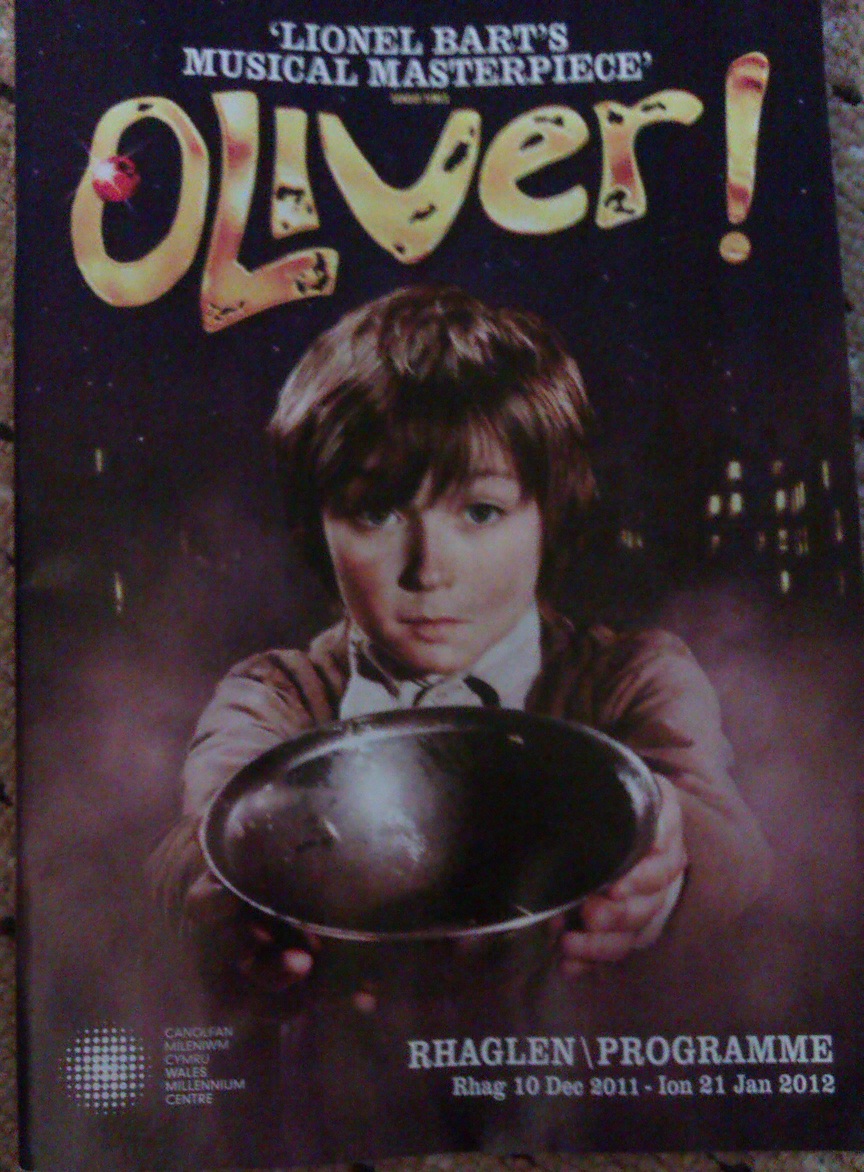
Review of Oliver at Wales Millennium Centre


 On the 29th December and 20th January I went to see Oliver! for the first time on stage at the Wales Millennium Centre.

I loved the film growing up. So much so that I became enamoured with the idea of being part of Fagin’s gang and organised a small gang of my own to do some pickpocketing at a local playscheme. Unfortunately, the reality of it was not all-singing and dancing. Instead, my conscience kicked in, I felt horribly guilty and I ended up sneaking the stuff back where I got it from, like it had never happened. I would have been the one putting things into pockets. A put-in-pocketer.

Anyway, the point is, for a film I grew up on, it has been a long time coming for me to see it on stage. But, it was worth the wait. I was absolutely captivated by it from beginning to end – mostly managing to stay in the world painted before me on stage, even during a school holiday matinee performance. Which of course means many restless children. Though, it must be said, aside from the sweet wrapper rustling and the occasional baby wailing loudly, the kids were mostly quiet. To me that says something about the quality of the production!  (see my previous blog post if angry rants are your thing).

The show opens onto the workhouse scene and it was immediately obvious how hard these boys have worked on this show and the energy they put into it was boundless. A comment on lighting here - particularly noticeable in the opening scene, where the boys utilise most of the downstage area – the very front of the stage gets a bit lost in darkness. Shadowy is fine, because it is after all a workhouse, but this was a line of dark. It’s not a major problem as that far downstage isn’t often used, but noticeable enough to be noteworthy.    

 Harry Polden played Oliver in both the performances I saw, which I was pleased about, as I know he’s good from seeing his performance of Gustave in Love Never Dies. This boy has a pretty accomplished theatre CV already for someone who is only 12 and has worked with some notable west end performers. He’s earned it though. It’s obvious that he really loves being part of this profession and consequently puts everything into his portrayal of these characters. He has flawless clarity in his diction and an angelic singing voice.  His portrayal of Oliver had just the right amount of naivity, maudlin and that controlled sadness.

The other performance that stood out again goes to the youngsters – those that played Artful Dodger. I don’t know who played him on 29th December because I was a bit of an idiot and completely missed the board with the cast list on. I do know that on January 20th, he was played by Joseph Potter. It was high praise from my theatre going companions who were all raving about the performances from the respective Artful Dodgers. I imagine this is a dream role for young actors, though, as he’s such an interesting character and leads one of the standout moments – the consider yourself scene.

The choreography in this scene particularly gelled together perfectly  - not just the choreography of the many performers on stage, but the scenery too  which seemed to dance around with them.  I found this scene is best appreciated from the circle, where I was sat on the 29th December (and for me to say this is something, as everyone who knows me will know that I’m a stalls fan)  

After the show last night my friend’s husband said to me that he didn’t realise how big the part of Fagin was and I think many people who aren’t very familiar with the story don’t realise. I would say the story is as much Fagin’s as it is Oliver’s. This highlighted in the fact that the final moment is that iconic image of Fagin walked into the bleeding sunset to whatever fate has in store.

Neil Morrissey handled this enormous challenge exceptionally, capturing every essence of the Fagin we all know – the juxtaposition of sleazy, selfish criminal with caring patriarch to these lost boys.  His singing voice was pleasant enough, by no means brilliant, but then, Fagin doesn’t need to be a great singer as it’s more about the character.

**Theatre snobbery open bracket**
As a rule, I dislike stunt casting, though I have come to expect it for roles such as this. One reason for this being how they play upon it. To me, the only time you should acknowledge that there is ‘a name’ in your show is in a pantomime (and Spamalot – but then that is like a panto for adults). I very much disliked being pulled out of the story for the sake of jokes such as ‘Can I fix it.... yes, I can’ (in reference to Neil Morrissey being the voice of Bob the Builder) but then other audience members lapped it up – so I guess it worked on the people they were trying to appeal to.
**Theatre snobbery close bracket**

Samantha Barks was brilliant casting in the role of Nancy. She has come a long way since taking part in ‘I’d do Anything’ not least noteworthy being her time as Eponine in Les Miserables , which she even got the honour of recreating for the 25th Anniversary Concert. She had tons of energy in this role – just watching ‘Oom Pah Pah’ wore me out, though I could tell that she and the rest of the cast love performing it. She really got to the heart of Nancy and had a good understanding of her bewildering commitment to Bill Sykes.

The only cast member who I felt was a bit of a weak link was Stephen Moore in the role of Mr Brownlow. I just felt his heart wasn’t really in it and it seemed a bit like he was reciting lines, rather than performing them. This only really applies to the performance I saw last night, so I don’t know if he was lacking energy but that shouldn’t matter.  If you’re in a production like this (or any production really) you need to pull the energy from somewhere, even if you’re not feeling it.

And lastly I just have to give a special mention to the boys who have been playing ‘Nipper’ for the awww factor – well played boys.

Tonight (21st January) is the last performance at the Wales Millennium Centre. It will be then be moving on to the Manchester Palace Theatre, where the current cast will resume their roles. The website, if you wish to visit it is www.oliverthemusical.com  

Friday, 30 December 2011

Letter to Lady in centre of Row H, Upper Circle, Thurs 29th Matinee at Oliver


Dear 29/30H,

The back of my chair was not your foot stool. I had every right to put my coat on the back of my chair and the fact that they therefore covered your feet was not a comment on how smelly your feet were. And breaking out of your welsh speaking to talk loudly about smelly feet in English, clearly for my benefit, just made it worse.

I’m not sure if you felt that being higher up the raked seating than me meant that you were elevated in rank. This isn’t the case, by the way. If you’re in the upper circle, you’re in the cheap seats whatever, so you can get over that right now. 

I felt that putting your feet on the back of my chair was not only rude and disrespectful to me, but the theatre as well. I didn’t see any of the many kids there doing that. Isn’t that just a little bit embarrassing for you?

While we’re on that – I’d been concerned about going to the matinee during the school holidays for fear of screaming kids with rustling sweets. Funnily enough, it turns that it was adults (that’s right, I mean you) that were more disruptive.

The quiet, intimate scenes between the big ensemble pieces are not an invitation for you to have a loud conversation. Those scenes are part of the show too; they contain relevant information to progress the story.

Why would you pay that much money to see a show, just for a catch up? There are cafes and pubs nearby. You could catch up there for the price of a round or two of drinks in an atmosphere where chatting is encouraged.

Even if the chatting is about the show... it can wait for the interval. If you really, really, can’t keep your obviously witty and deep observation until then, then whisper it to the person next to you. Whispering is where you lower the volume of your voice so only people very close by can hear, in case you weren’t sure.

Though I can’t understand the need to have food and drink in the theatre, I appreciate lots of people nowadays have a compulsion to do this like they’re in some gigantic living room waiting for Eastenders to come on.  However, if you (an adult, I remind you) drop your juice box on the floor (that’s right, a juice box!) please don’t kick it so it drops under the seat in front of you so it’s leaking under that persons chair instead. This made my sister feel very twitchy in the second half, drawing attention away from the performance to wonder whether her bag was getting soaked in E number rich liquid.

As great as it is that shows like Oliver draw in a crowd that may not otherwise go to the theatre, it’s disappointing that it also brings with it a lack of theatre etiquette which, really, is just a matter of being well behaved and mindful that there are other people trying to enjoy the show around you.

“Don’t put your feet on the back of someone else’s chair” is just, generally, good manners.

Mmmkay.

Wednesday, 7 December 2011

The Professional Amateur


Does amateur dramatics have to mean amateur dramatics?

This question is prompted by the combination of a show I worked on last week and an aptly timed tweet by Brian McCann:-


I’ve worked on and seen a lot of amdram and the quality ranges from cringeworthingly embarrassing to pro-theatre standard.

 It makes me wonder, what makes the difference? When it all falls under the bracket of amateur, why is some so much better than others?

I think it mostly falls down to attitudes. An amateur attitude i.e. ‘oh, it doesn’t matter, it’s just an amateur production’ will, ultimately result in a poor quality show. A show where the performers are under rehearsed, stage managers left feeling clueless and any set/props that’ll just “do” – ‘it’s not of the time period and looks completely out of place, but it’s just amdram, so it’ll do’.

Sometimes, though, these attitudes are understandable. After all, everyone is volunteering their time and, therefore, peoples paid employment has to take precedence. There is also a general lack of budget, which ultimately means more time needs to be given to the task of looking for cheap alternatives. Time being something that is hard to come by if you are trying to hold down a day job and are doing the show in your spare time; Dedicating all spare time to the production results in decline of basic needs such as eating and washing.

So, is there another level of amateur? There’s the purely amateur performer then there’s the professional amateur?! – Someone who:-
(a)    doesn’t have other commitments in life and has the luxury of dedicating a lot of time to this unpaid pursuit  OR
(b)   does have a lot going on, but sacrifices other things (such as eating meals and having a good nights sleep) during the rehearsal period – in particular, production week.

I think most people who I would call a ‘professional amateur’ fall into the second category;  Many performing arts students/ graduates hoping to make the leap to professional actor/ stage manager/ technician through building up experience. And amdram is an excellent way to build up experience. Especially if the show you’re involved in is one that ends up on the top end of the scale of quality.

The aforementioned amdram show I worked on last week was, unfortunately, one of the ones from the lower end of the scale. That’s not to say that there weren’t individual cases of excellence. The props looked amazing, but then a lot of money had been splashed out on buying them in from prop hire companies - much, much more money than most amateur companies can afford. They have no excuses about budget constraints for poor quality, then.  

THE GOOD – Not just good, but outstanding, actually - Two youngsters who were the saviour of the production. Their professionalism shone out through the fog of dodgy direction and sloppy dance routines and I feel certain that this’ll lead from professional amateur to pure professional one day.

THE BAD –  Most of it. Particular low lights –  Lighting design too patchy and dark (to be literal), dodgy singing - out of tune and out of time, lack of information generally for crew and performers, badly choreographed dance routines.   
One dance routine in particular stood out in its amateur nature. It was like watching a dance made up by 12 year olds in a school production. Some of the ‘dancers’ were actually looking to the others during the performance to check they were either (a) in time or (b) doing the right moves.
Come on guys, nothing looks more unprofessional than nervous performers looking to each other for next moves/ reassurance (cue response of ‘but we’re not professionals, we’re an amateur dramatics society’)

THE UGLY – An incident which was a result of lack of communication. On the last evening, after the bows, some semi important person was to give a speech. There was no closing of the curtains at the end, so on previous evenings the performers had simply walked offstage.  However, on this evening, the information of the speech had not found its way to all the performers. The result? Some people wandering offstage, some staying put and some hovering between being on and off stage. The lights were also coming up and down in the confusion. It was all a bit of a car crash.


Anyway, I won’t name and shame the company – I went out of my way to not find out what company it was, so I wouldn’t feel tempted. I don’t think it’ll benefit theatre in general to ‘out’ them. But if anyone reading wants to give a shout out for amdram societies that are known for their professionalism, then go ahead. Just say who they are and where you can find them.

In a climate where a lot of people can’t afford to see the professional shows, amateur dramatics are an important part of keeping theatre alive and people interested. I think there’s a duty for all amdram societies to put on a show that is the best it can be. They will, by no means, be of a completely professional standard, but if we could strive for a professionally amateur show, I think that's the least to ask for. 


My shout outs:-
The Sir Harry Secombe Trust  – I always come away from their shows feeling like I’ve just watched a professional show and they’re all under 21. Absolutely outstanding.

Abbey Players – I work with them, so I may be a bit biased, but they have a secure ‘fan base’ and feedback is always brilliant. Singing quality is always excellent.

Both companies can be found performing at Swansea's Grand Theatre.